

ABOUT
Scout is RVLock’s first IoT line: connected security and safety devices for RVs, managed through one app. It took the brand beyond door hardware for the first time.
I created the Basecamp Design Guide, a mathematically driven design language of compound profiles, Z-curves, and dynamic bevels. It scales from a 32mm asset tracker to a 150mm camera. I also led industrial and mechanical design of the Gateway, the hub that connects every device.
Unreleased — process shown with sensitive details omitted.
YEAR:
2025–2026
ROLE:
Industrial Design, Design Systems, Design Engineering

PROCESS
THE PROBLEM
A new product category with no design language to build from. The family had to span cameras, sensors, trackers, and a hub with very different sizes and constraints, yet read as one RVLock family. Research centered on a tech-forward RVer who wants easy install, smart integration, and a maintenance-free experience.

Target user and existing products in the space.
COMPOUND PROFILE
DESIGN SYSTEM
Every outline is built by blending several radii into one continuous curve, all derived from product width A. On a rectangle: B = 110% of A, C = 36% of A, D = 90% of A, E = 107% of A/2. Change the width and the silhouette rescales correctly. I built it as a parametric Onshape master so every product starts from the same formulas.


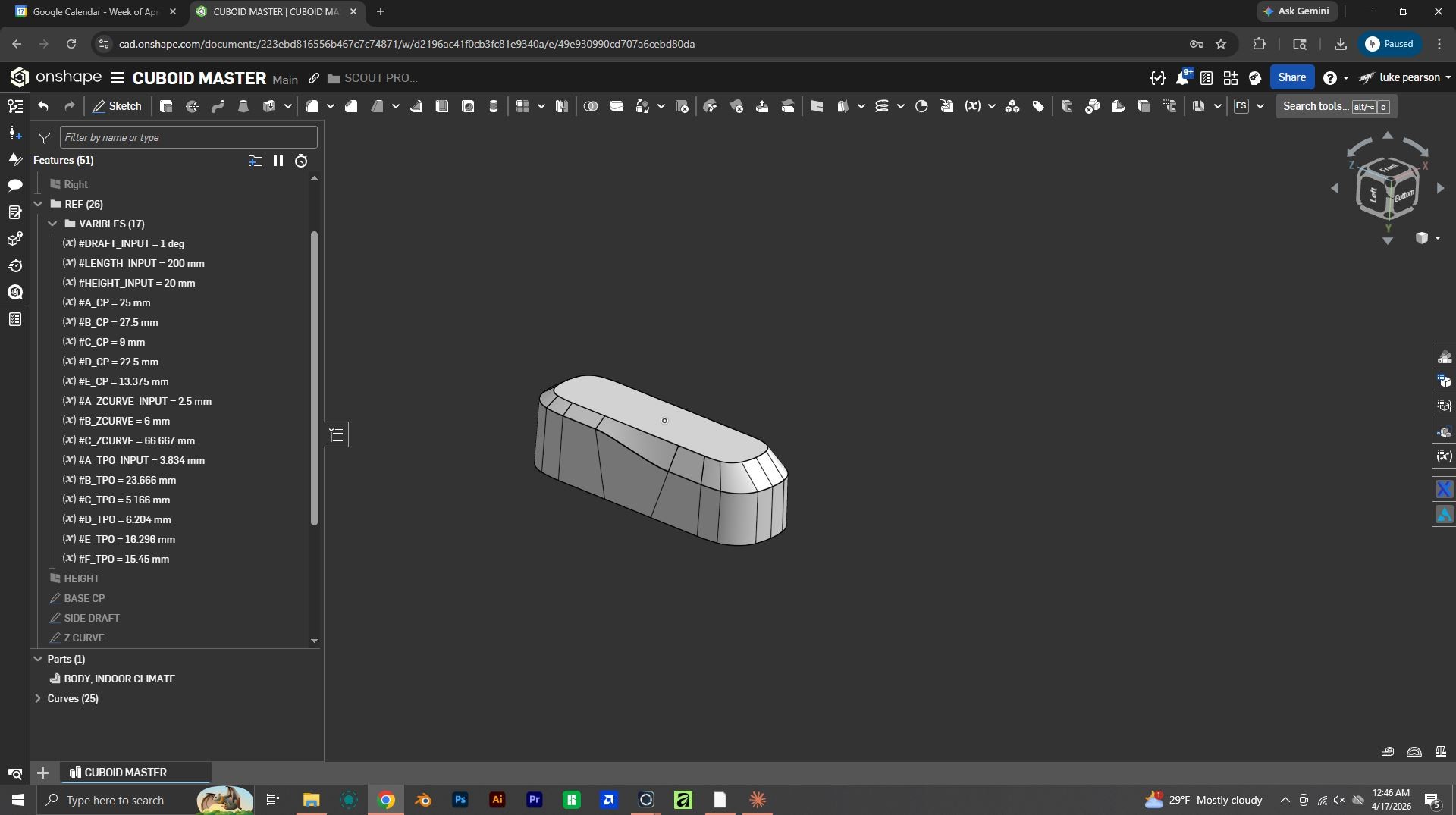
Rectangle and square profiles, driven by variables in the Onshape master.
Z-CURVE
DESIGN SYSTEM
A surface transition that keeps forms from looking static as they rotate. Edge B derives from edge A at a 5:12 ratio, A sets a 36° bevel, and the curve spans one-third of the face. On flat faces it runs from 0.24 to 0.618 magnitude to smooth the transition.


Z-curve on flat and cylindrical faces.
DYNAMIC BEVEL
DESIGN SYSTEM
An angled surface whose width, angle, and height shift around the perimeter. Its top profile offsets derive from the Z-curve’s 36° bevel, the compound profile, and the golden ratio, so it stays proportional on any product. It carries RVLock’s signature detail from Trek and V4 into IoT.


Bevel tied to the Z-curve, with top profile offset formulas.
GATEWAY
The hub had to fit antennas up to 175mm without looking like a router. I benchmarked how the market handles large antennas, sized connectors to a 100 × 100 × 30mm enclosure, and sketched hidden, flip-out, integrated, and external directions. Hiding antennas behind a large cover was ruled out because it put them too close to the PCB. Three concepts applied the design language in CAD.


Antenna exploration, from market research to three CAD concepts.
GATEWAY ENGINEERING
A DFMA review put the PCBA and antenna sub-assemblies on one housing half, cutting assembly flips and protecting antenna cable runs. I reapplied the compound profile from the front face to match the rest of the family, borrowed part splits from the camera to form a port area, and designed snap-fit housing halves, a wall mount, and packaging.


Snap-fit housing, concealed ports, wall mount, and packaging.
DESIGN APPLICATION
The same rules were applied across the line, each product with its own constraints. The camera bevel tightens around the lens and widens below it. The door sensor is modeled as one body and then split, so its bevels align when the door closes. The TPMS turns the bevel into an embossed grip. Zebra analysis checked surface continuity.


One language, different constraints — camera, sensors, and TPMS.
CMF & LOGO
Four colorways match RVLock’s palette: black, white, warm gray (Pantone 13-0905 TPG), and tan (Pantone 18-0601 TPG). Three debossed logo sizes, 8, 10, and 15mm, each with a set edge radius and 0.2mm depth, keep branding consistent at every scale.


Colorways and logo spec.
RESULTS
The Basecamp Design Guide gave RVLock a scalable ID system for its first connected product line — one cohesive family across every device. New products can be designed to the system rather than from scratch.


